Last Updated: August 2026
Published by: Orio Pharma — a specialist oncology medicine supplier serving patients, pharmacies, and distributors worldwide.
Medical Review: Reviewed by Dr. Rakib Uddin Ahmed, MBBS, MD (Hematology)
Content Basis: This article is based on official prescribing information, product monographs, and regulatory product documentation from FDA and DGDA (Directorate General of Drug Administration, Bangladesh).
Sources: drugs.com, drugs.com, accessdata.fda.gov, accessdata.fda.gov
Key Takeaways
- Ruxolitinib Cream is a topical JAK1/JAK2 inhibitor formulated as a 1.5% cream, approved for short-term and non-continuous chronic treatment of mild to moderate atopic dermatitis in non-immunocompromised patients aged 2 years and older, as well as for nonsegmental vitiligo in patients aged 12 years and older.
- The cream is for topical skin use only and must not be applied to the eyes, mouth, or vaginal mucosa; systemic absorption is limited by design.
- Common side effects include nasopharyngitis, diarrhea, bronchitis, ear infection, and application site pain, while serious risks include infections, malignancy, major adverse cardiovascular events, thrombosis, and blood-related abnormalities.
- We supply Bangladesh-manufactured brands Ruxotor, Ruxonib, and Rutinib, produced by manufacturers including Everest Pharmaceuticals Ltd., Drug International Ltd., and Drug International Pharma Ltd.
- These brands are exported for institutional and pharmacy-level procurement to the United States, with additional availability for buyers in the United Arab Emirates and Bangladesh, rather than for individual retail purchase.
- Pharmacies, clinics, and distributors can contact us directly for details on tube sizes, minimum order quantities, documentation, and shipping timelines.
What is Ruxolitinib Cream?
Ruxolitinib Cream is a topical Janus kinase (JAK) inhibitor formulated as a 1.5% cream for dermatological use. It belongs to the pyrrolopyrimidine class of Janus Kinase Inhibitors, applied directly to affected skin rather than administered systemically. The product is approved for the short-term and non-continuous chronic treatment of mild to moderate atopic dermatitis in non-immunocompromised patients aged 2 years and older, as well as for nonsegmental vitiligo in patients aged 12 years and older.
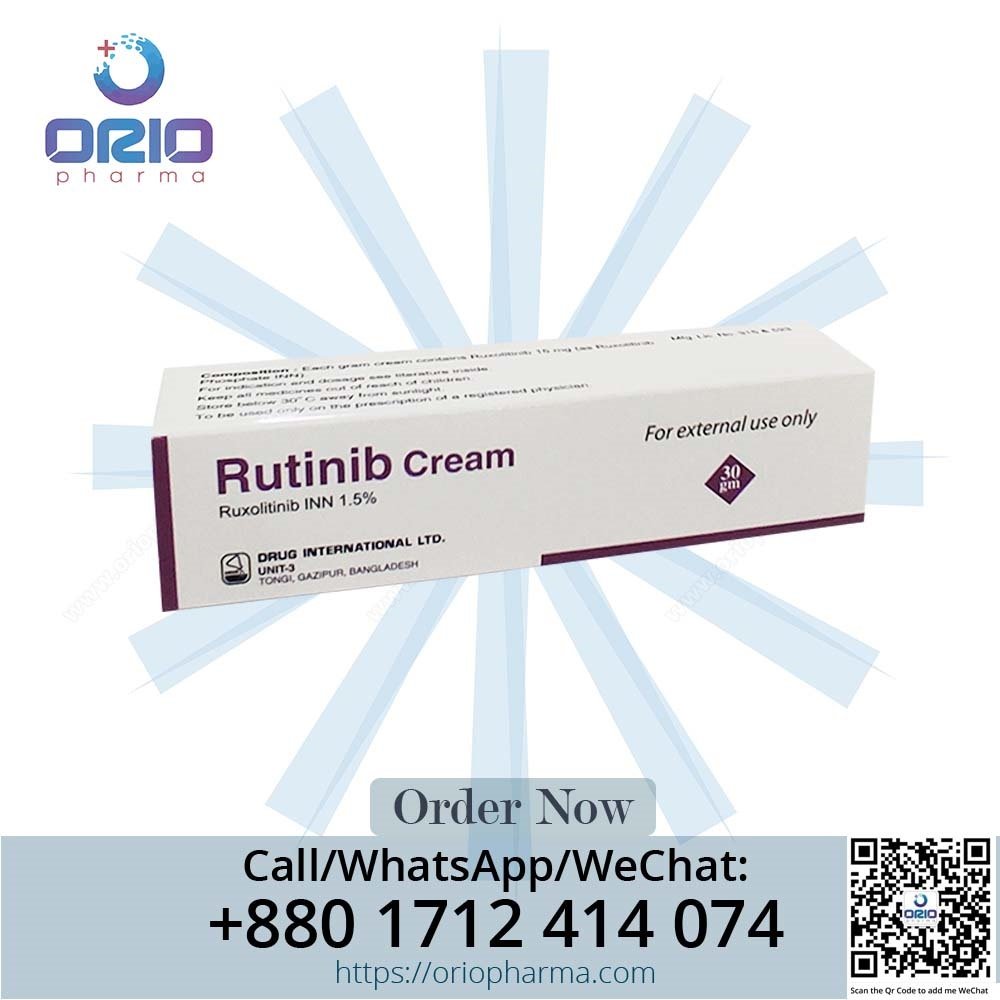
In the United States, this molecule is widely recognized under its originator brand, marketed by Incyte, and this naming context is relevant for pharmacies and clinicians familiar with the US retail market. As a Bangladeshi pharmaceutical supplier, we work exclusively with Bangladesh-manufactured formulations of ruxolitinib cream, supplied under the brand names Ruxotor, Ruxonib, and Rutinib. Each of these brands delivers the same active ingredient, ruxolitinib, formulated as a 1.5% topical cream.
These brands are intended for institutional and pharmacy-level procurement rather than individual retail sale, and are positioned as export-ready alternatives for markets that source Bangladeshi-manufactured pharmaceutical products. Buyers evaluating options for atopic dermatitis or vitiligo treatment protocols can review our detailed sourcing overview, such as our Rutinib Cream availability and sourcing guide, for additional context on international supply patterns.
The remainder of this article outlines the mechanism, safety profile, regulatory status, and supply details relevant to pharmacies, clinics, and distributors evaluating Ruxotor, Ruxonib, and Rutinib for institutional procurement. The clinical and pharmacological information referenced throughout draws on publicly available FDA prescribing information and product labeling for topical ruxolitinib formulations; readers should always verify current details against the official label applicable to their region.
Mechanism of Action and Clinical Profile
Ruxolitinib inhibits Janus kinase 1 (JAK1) and Janus kinase 2 (JAK2), enzymes that mediate intracellular signaling for cytokines and growth factors involved in immune function and hematopoiesis. By blocking JAK1/JAK2-dependent signaling pathways, ruxolitinib cream reduces the inflammatory cytokine activity implicated in atopic dermatitis and the immune-mediated melanocyte destruction associated with nonsegmental vitiligo.
Pharmacokinetic data indicate a mean terminal half-life of approximately 116 hours following topical application, with plasma protein binding of approximately 97%. Clinical data show no evidence of ruxolitinib accumulation following daily topical application for 28 days in patients with atopic dermatitis. Systemic absorption is limited by design, consistent with its role as a localized topical therapy. Elimination occurs primarily through the renal and hepatic-biliary routes, with ruxolitinib and its metabolites excreted mainly in urine (approximately 74%) and feces (approximately 22%); less than 1% is excreted unchanged. These pharmacokinetic characteristics are relevant to prescribers assessing drug interaction potential and administration planning, though specific dosing decisions remain the responsibility of the treating physician.
Because these pharmacokinetic parameters derive from formal clinical trial data, pharmacy staff fielding institutional inquiries should direct clinicians to the full prescribing information for population-specific interaction data, rather than relying on summarized figures alone.

Safety Information: Side Effects
Clinical data for ruxolitinib cream identify a defined profile of common and serious adverse effects that prescribers and pharmacists should be familiar with when counseling on this therapy. Commonly reported reactions include nasopharyngitis, diarrhea, bronchitis, ear infection, eosinophil count increased, urticaria, folliculitis, tonsillitis, rhinorrhea, pyrexia, and application site pain.
These effects are generally manageable but should be monitored throughout treatment.
More serious risks associated with JAK inhibition include serious infections that may lead to hospitalization or death, including tuberculosis and bacterial, invasive fungal, viral, and other opportunistic infections. Additional serious risks include increased all-cause mortality, malignancy, major adverse cardiovascular events (MACE), thrombosis, and hematologic abnormalities such as thrombocytopenia, anemia, neutropenia, leukopenia, and lymphopenia.
Dosing frequency, treatment duration, and application extent must be determined exclusively by the prescribing physician in accordance with the official prescribing information. This article does not provide dosing guidance and is intended for supply-chain and regulatory reference purposes only. Institutional buyers should ensure that any patient-facing materials distributed alongside these products are reviewed by qualified clinical or regulatory staff prior to use.
US Regulatory Status and Approved Use
Ruxolitinib was first approved in the United States in 2011 as an oral therapy for certain hematologic conditions. The topical 1.5% cream formulation received separate FDA approval in 2021 for dermatological indications, marking a distinct regulatory pathway specific to topical JAK inhibition.
The FDA-approved indications for the topical cream formulation include short-term and non-continuous chronic treatment of mild to moderate atopic dermatitis in non-immunocompromised patients aged 2 years and older, and treatment of nonsegmental vitiligo in patients aged 12 years and older. These age and indication parameters are consistent across FDA labeling and should guide procurement decisions for pharmacies serving pediatric and adult dermatology patients.
As a Bangladesh-based pharmaceutical supplier, we export Ruxotor, Ruxonib, and Rutinib to healthcare distributors and institutional buyers in the United States in accordance with applicable import and regulatory requirements. These products are manufactured in Bangladesh and are not produced domestically within the United States; all regulatory compliance for US import and distribution remains the responsibility of the receiving pharmacy, distributor, or institution in coordination with FDA requirements. We recommend that procurement teams cross-reference their internal regulatory checklists against current FDA import guidance before finalizing any order.
Availability / Supply Information
Ruxotor, Ruxonib, and Rutinib are manufactured in Bangladesh by established pharmaceutical companies, including Everest Pharmaceuticals Ltd., Drug International Ltd., and Drug International Pharma Ltd. Each brand is formulated as a 1.5% ruxolitinib cream and regulated domestically under the Directorate General of Drug Administration (DGDA) in Bangladesh.
These brands are available in multiple tube sizes to accommodate institutional and pharmacy ordering needs, commonly cited as 60 g, 100 g, and 120 g. Buyers should note that package size availability can vary by brand and distributor listing, with some sources indicating smaller tube sizes for certain products; buyers are encouraged to confirm exact pack sizes at the time of inquiry.
We export these Bangladeshi-manufactured ruxolitinib cream brands to pharmacies, clinics, and distributors in the United States, as well as to institutional buyers in the United Arab Emirates and within Bangladesh. Our supply chain is structured for B2B procurement rather than individual patient purchase. For current availability, minimum order quantities, and shipping timelines, contact us directly — we do not publish pricing publicly, and all cost information is provided upon inquiry.

Can Pharmacies and Institutional Buyers Order from Us?
Our supply operations are structured specifically for business-to-business transactions. We work with licensed pharmacies, dermatology clinics, hospital procurement departments, and pharmaceutical distributors seeking Bangladeshi-manufactured ruxolitinib cream brands for institutional stocking or resale within their regulatory frameworks.
Institutional buyers located in the United States, United Arab Emirates, and Bangladesh may submit inquiries regarding product availability, documentation, and shipping logistics for Ruxotor, Ruxonib, and Rutinib. We are equipped to support recurring institutional orders as well as one-time bulk procurement requests.
Individual patients seeking ruxolitinib cream for personal use should consult a local licensed pharmacy or their prescribing physician, as we do not process retail or individual patient orders. Pharmacies, clinics, and distributors interested in establishing a supply relationship are encouraged to contact us directly to discuss institutional order requirements, documentation needs, and available brand options.
Product Specifications
- Generic name: Ruxolitinib
- Brand names: Ruxotor, Ruxonib, Rutinib
- Strength: 1.5% cream (15 mg ruxolitinib per gram, equivalent to 19.8 mg ruxolitinib phosphate per gram)
- Therapeutic class: Pyrrolopyrimidines (Janus Kinase Inhibitor, topical)
- Dosage form: Topical cream
- Manufacturers: Everest Pharmaceuticals Ltd., Drug International Ltd., Drug International Pharma Ltd.
- Tube sizes: 60 g, 100 g, 120 g (variation noted across distributor listings)
- Relevant metabolic pathways: CYP3A4, CYP2C9 (important for drug interaction assessment)
These specifications reflect information available at the time of publication. Institutional buyers should confirm current formulation details, batch documentation, and Certificate of Analysis data directly with us prior to procurement, as manufacturing specifications may be updated periodically by the listed manufacturers.
Related Products
Institutional buyers sourcing Ruxotor, Ruxonib, or Rutinib may also be interested in exploring our broader dermatology and JAK-inhibitor category offerings, which include additional topical and systemic immunomodulatory therapies suited to dermatology and rheumatology procurement needs. Our catalog is organized to help pharmacies and distributors identify Bangladeshi-manufactured alternatives across multiple therapeutic categories. For related oral JAK-inhibitor options and other specialty pharmaceutical categories, contact our team for a full product list tailored to your institutional requirements.
Frequently Asked Questions
What is ruxolitinib cream used for?
Ruxolitinib cream is a topical JAK1/JAK2 inhibitor approved for the short-term and non-continuous chronic treatment of mild to moderate atopic dermatitis in non-immunocompromised patients aged 2 years and older, as well as for nonsegmental vitiligo in patients aged 12 years and older. It works by reducing inflammatory cytokine activity involved in atopic dermatitis and immune-mediated melanocyte destruction in vitiligo. It is applied directly to affected skin and is not intended for systemic use.
How much does ruxolitinib cream cost?
Pricing is not published publicly, as our supply operations are structured for institutional and pharmacy-level procurement rather than individual retail sale. Pharmacies, clinics, and distributors can contact us directly to receive current cost information, minimum order quantities, and shipping timelines for Ruxotor, Ruxonib, and Rutinib. Individual patients should consult a local licensed pharmacy for retail pricing.
What is the maximum age to use ruxolitinib cream?
The article does not specify a maximum age limit; the FDA-approved indications state the cream is approved from 2 years of age for mild to moderate atopic dermatitis and from 12 years of age for nonsegmental vitiligo. Prescribing decisions for any specific patient, including older adults, remain the responsibility of the treating physician. Buyers and clinicians should refer to official FDA labeling for complete age-related guidance.
What are the serious side effects of ruxolitinib cream?
Serious risks associated with this JAK inhibitor include serious infections that may lead to hospitalization or death, such as tuberculosis and bacterial, fungal, or viral infections. Additional serious risks include increased all-cause mortality, malignancy, major adverse cardiovascular events (MACE), and thrombosis. Hematologic abnormalities such as thrombocytopenia, anemia, neutropenia, leukopenia, and lymphopenia have also been reported, and patients should be monitored accordingly under physician supervision.
Do you supply ruxolitinib cream to pharmacies in the United States?
Yes, we export Bangladesh-manufactured Ruxotor, Ruxonib, and Rutinib to healthcare distributors, clinics, and institutional buyers in the United States in accordance with applicable import and regulatory requirements. These products are manufactured in Bangladesh and are not produced domestically within the United States, so regulatory compliance for import and distribution remains the responsibility of the receiving pharmacy or institution. We also support institutional buyers in the United Arab Emirates and within Bangladesh.
Can individual patients order ruxolitinib cream directly from you?
No, our supply chain is structured exclusively for business-to-business transactions with licensed pharmacies, dermatology clinics, hospital procurement departments, and pharmaceutical distributors. We do not process retail or individual patient orders. Individual patients seeking this treatment should consult a local licensed pharmacy or their prescribing physician.
Access This Medicine Through Orio Pharma
We are a specialist oncology medicine supplier delivering to patients, pharmacies, hospitals, and distributors worldwide. Contact us for availability and sourcing support.
We do not publish prices online. All pricing is provided directly by our specialist supply team on request.
Medical Information Notice: This content is for informational purposes only and is based on official pharmaceutical product documentation. It does not constitute medical advice. Patients should consult their doctor or pharmacist before taking any medication.
Regulatory Disclaimer: Sourcing and distribution are subject to regional import regulations, quotas, and verified medical prescriptions where applicable. Pricing and availability are subject to change without notice.
Content Currency: This article was last reviewed and updated in August 2026. Regulatory approval statuses and product availability are subject to change; readers are advised to consult official regulatory databases for the most current information.