
Last Updated: June 2026
Published by: Orio Pharma — a specialist oncology medicine supplier serving patients, pharmacies, and distributors worldwide.
Medical Review: Reviewed by Dr. Farhan Hossain, MBBS, MD (Oncology)
Content Basis: This article is based on official prescribing information, product monographs, and regulatory product documentation from the FDA, EMA, and DGDA (Directorate General of Drug Administration, Bangladesh).
Sources: astrazeneca.ca, ec.europa.eu, medicalinformation.astrazeneca-us.com, accessdata.fda.gov, accessdata.fda.gov, accessdata.fda.gov, accessdata.fda.gov
Key Takeaways
- Fulvestrant is a nonagonist estrogen receptor (ER) antagonist — not a chemotherapy or immunotherapy — that works by competitively binding to the estrogen receptor and downregulating ER protein in hormone-sensitive breast cancer cells.
- It is approved across three distinct indications in postmenopausal women with HR-positive advanced breast cancer, covering treatment-naïve patients, those who have progressed on adjuvant anti-estrogen therapy, and those with metastatic disease following antiestrogen treatment.
- Unlike tamoxifen (a SERM with partial agonist activity) and anastrozole (an aromatase inhibitor that reduces estrogen production), fulvestrant acts directly at the estrogen receptor with no partial agonist effect and has demonstrated activity against tamoxifen-resistant breast cancer cells.
- Common side effects include nausea, diarrhea, hot flash, asthenia, and musculoskeletal pain; serious risks include hypersensitivity reactions, elevated hepatic enzymes, and increased bleeding risk in susceptible patients.
- Fulvestrant has no known drug-drug interactions, which simplifies co-administration planning in complex oncology regimens.
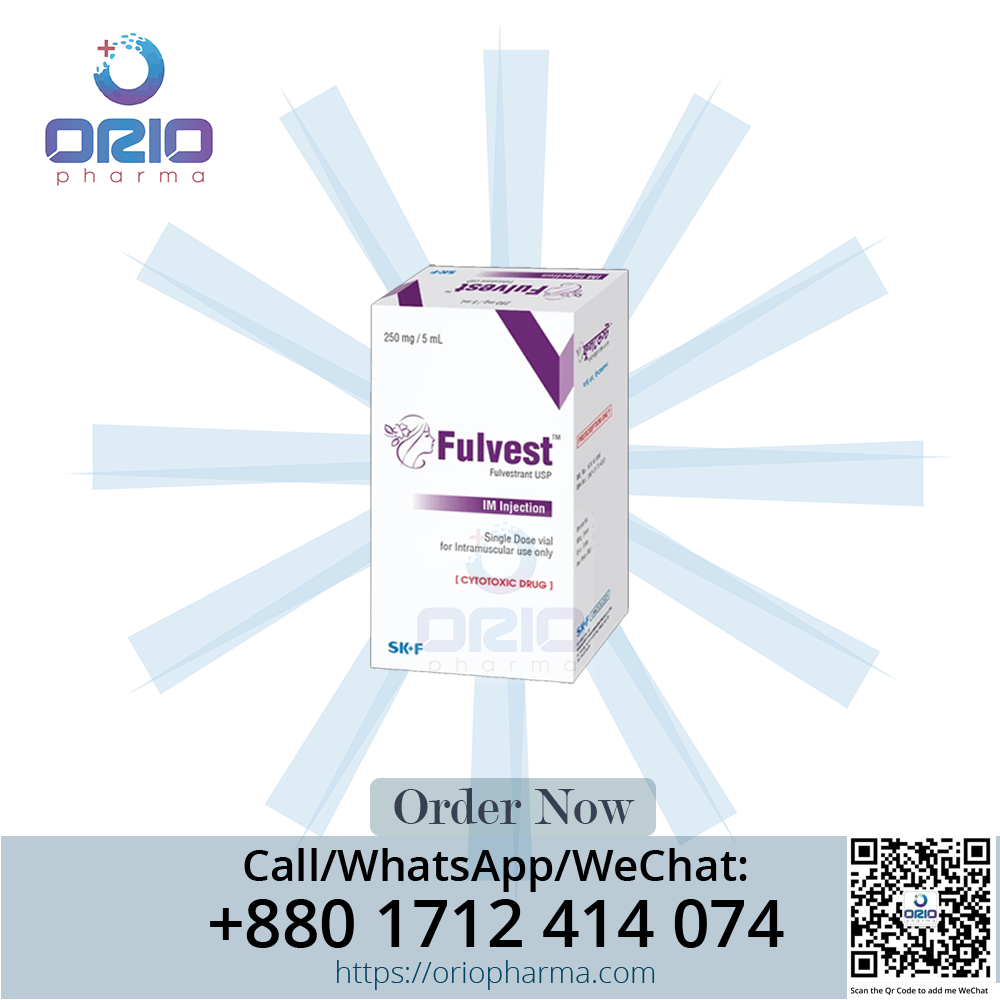
- We supply two fulvestrant brands — Fulvest and Fulvestrant — both as 250 mg/5 mL pre-filled syringes for intramuscular administration, to hospital and institutional buyers in Saudi Arabia and the wider GCC region.
What Is Fulvestrant and How Does It Work?
Fulvestrant is a targeted endocrine therapy classified as an estrogen receptor (ER) antagonist. It is neither a chemotherapy agent nor an immunotherapy — a distinction that matters when counseling patients or building oncology formularies. Its mechanism of action differs fundamentally from cytotoxic drugs: rather than disrupting cell division broadly, fulvestrant acts selectively at the estrogen receptor in hormone-sensitive breast cancer cells.
At the molecular level, fulvestrant binds competitively to the estrogen receptor with an affinity comparable to that of estradiol itself. This high-affinity binding downregulates ER protein in human breast cancer cells, reducing the receptor population available to drive tumor proliferation. Critically, fulvestrant is a nonagonist ER antagonist, meaning it exerts no partial agonist activity at the estrogen receptor. This sets it apart mechanistically from selective estrogen receptor modulators (SERMs), which retain some degree of estrogen-like activity in certain tissues.
By blocking the trophic actions of estrogens without any partial agonist effect, fulvestrant occupies a distinct class within targeted endocrine therapy for HR-positive, HER2-negative advanced breast cancer. For procurement professionals and oncology pharmacists building treatment protocols, understanding this mechanism is foundational to appreciating its clinical positioning. To learn more about how targeted therapies are reshaping oncology, see our overview on the role of targeted therapy in cancer treatment.
Approved Indications: HR-Positive Advanced Breast Cancer
Fulvestrant carries regulatory approval across three distinct clinical indications, all within the spectrum of hormone receptor-positive advanced breast cancer in postmenopausal women. Each indication reflects a different stage of disease progression and prior treatment history, making fulvestrant a versatile agent across the HR-positive treatment continuum.
First indication: treatment of hormone receptor (HR)-positive, human epidermal growth factor receptor 2 (HER2)-negative advanced breast cancer in postmenopausal women who have not previously received endocrine therapy — positioning fulvestrant as a frontline endocrine option for treatment-naïve patients with advanced disease.
Second indication: HR-positive, HER2-negative advanced breast cancer in postmenopausal women, including those who have not received previous endocrine therapy, as well as those whose disease has progressed on or after anti-estrogen therapy, or during therapy with an anti-estrogen — covering patients who have relapsed following standard adjuvant hormonal treatment.
Third indication: HR-positive metastatic breast cancer in postmenopausal women with disease progression following antiestrogen therapy — addressing the metastatic setting where prior endocrine agents have failed.
Across all three indications, the patient population is consistently defined as postmenopausal women with HR-positive disease. Specific dosing regimens, administration schedules, and any required dose modifications are determined by the treating physician in accordance with the official prescribing information. Procurement teams should note that all three indications are supported by the same formulation, simplifying formulary management.
Fulvestrant vs. Anastrozole and Tamoxifen: Key Clinical Distinctions
Two of the most frequent clinical questions in HR-positive breast cancer management concern how fulvestrant compares to anastrozole and tamoxifen. These are not interchangeable agents — they differ fundamentally in mechanism, receptor interaction, and clinical utility.
Fulvestrant vs. Anastrozole: Mechanistic Differences
Fulvestrant vs. Anastrozole: Anastrozole is an aromatase inhibitor — it works by suppressing estrogen biosynthesis, reducing circulating estrogen levels that would otherwise stimulate ER-positive tumor growth. Fulvestrant, by contrast, does not affect estrogen production. Instead, it acts directly at the estrogen receptor, competitively binding with high affinity and downregulating ER protein expression. These are mechanistically distinct approaches to estrogen pathway blockade and may be used at different points in the treatment sequence.
Fulvestrant vs. Tamoxifen: Agonist Activity Profile
Fulvestrant vs. Tamoxifen: Tamoxifen is a selective estrogen receptor modulator (SERM) with partial agonist activity — it can exert estrogen-like effects in certain tissues, which contributes to both its benefits and its risks. Fulvestrant is a nonagonist ER antagonist with no partial agonist activity whatsoever. This distinction has direct clinical consequences: fulvestrant has been shown to inhibit the growth of tamoxifen-resistant breast cancer cells in vitro, and to suppress tamoxifen-resistant breast tumors in vivo. For patients whose disease has progressed on tamoxifen, fulvestrant offers a mechanistically differentiated option.
These distinctions matter for oncology pharmacists and procurement specialists assessing formulary positioning and treatment-sequencing protocols.
Product Specifications and Available Brands
Fulvestrant is formulated as a 250 mg/5 mL solution for intramuscular injection, supplied in a pre-filled syringe. This ready-to-administer format supports clinical efficiency in oncology infusion and injection settings, eliminating the need for reconstitution and reducing preparation time at the point of care.
From a physicochemical standpoint, fulvestrant exhibits very high lipophilicity and extremely low aqueous solubility. It is, however, highly soluble in alcohols and glycols — properties that inform its formulation as an intramuscular depot injection and its pharmacokinetic behavior following administration.
We supply two Bangladeshi-manufactured brands of fulvestrant injection for the Saudi Arabia and broader Middle East market:
- Fulvest (Eskayef Pharmaceuticals Ltd.) — 250 mg/5 mL pre-filled syringe
- Fulvestrant (ZAS Corporation) — 250 mg/5 mL pre-filled syringe
Both brands share the same active ingredient, strength, and route of administration. Procurement teams sourcing fulvestrant injection for hospital formularies or oncology clinics in Saudi Arabia can inquire about brand-specific availability and batch documentation through our sourcing team.
Safety Profile: Side Effects and Precautions
A thorough understanding of fulvestrant’s safety profile is essential for clinical pharmacists, oncology nurses, and procurement teams supporting treatment protocols in Saudi Arabia.
Common Side Effects
Common side effects most frequently reported include nausea, diarrhea, vomiting, constipation, and abdominal pain. Respiratory symptoms such as cough and dyspnea have been observed. Dermatological reactions including rash and pruritus may occur, as may alopecia. Systemic effects include hot flash, asthenia, anorexia, musculoskeletal pain, peripheral edema, pyrexia, and dizziness. These are generally manageable within a monitored oncology setting.
Serious Adverse Effects
Clinicians should be aware of the following serious risks:
- Hypersensitivity reactions, including urticaria and angioedema, have been reported and require prompt clinical assessment.
- Bleeding risk is elevated in patients with bleeding diatheses, thrombocytopenia, or those receiving anticoagulant therapy. The intramuscular route of administration warrants particular caution in these populations.
- Hepatic enzyme elevations (ALT, AST, and ALP) exceeding 15% have been documented in clinical use. These elevations were not found to be dose-dependent, and hepatic monitoring is advisable during treatment.
Lactation Guidance
Women should be advised not to breastfeed during treatment with fulvestrant and for one year after the last dose. This guidance should be communicated clearly at the point of prescribing and dispensing.
All prescribing decisions, monitoring protocols, and management of adverse events should follow the official prescribing information under the supervision of a qualified oncologist.
Regulatory Status and Market Context in Saudi Arabia
Fulvestrant carries robust international regulatory credentials. It received FDA approval in 2002 and subsequently obtained approval from the European Medicines Agency (EMA) for its oncology indications in HR-positive advanced breast cancer. These approvals rest on substantial clinical evidence supporting its use across the postmenopausal HR-positive disease spectrum.
For the Saudi Arabian market, the Saudi Food and Drug Authority (SFDA) plays the central regulatory role in evaluating and approving oncology imports. The SFDA’s assessment framework for oncology products generally references established approvals from major international agencies, including the FDA and EMA, as part of its evaluation process. Procurement professionals importing fulvestrant into the Kingdom should ensure documentation aligns with SFDA import requirements and that supplied brands carry appropriate regulatory traceability.
Globally, ER antagonists occupy a well-established position in the management of postmenopausal HR-positive advanced breast cancer, both as monotherapy and increasingly in combination regimens with CDK4/6 inhibitors and other targeted agents. Quality-manufactured alternatives have expanded formulary options for health systems across the Middle East region.
As breast cancer incidence continues to rise across the Gulf Cooperation Council (GCC) countries, demand for reliable, documented oncology supply chains — including fulvestrant injection — remains a priority for hospital procurement departments and national health programs in Saudi Arabia.
Why Source Fulvestrant Through Us for the Saudi Market?
We are a Bangladeshi pharmaceutical supplier specializing in the procurement and export of oncology medicines to the Saudi Arabia and broader Middle East market. Our fulvestrant portfolio comprises two Bangladeshi-manufactured brands — Fulvest and Fulvestrant — both available in the 250 mg/5 mL pre-filled syringe format approved for intramuscular administration.
The pre-filled syringe presentation offers practical advantages for oncology clinics and hospital pharmacies: it eliminates reconstitution steps, supports accurate dosing administration, and reduces preparation burden on clinical staff — an important consideration for high-volume oncology centers in Riyadh, Jeddah, and across the Kingdom.
From a formulary management perspective, fulvestrant has no known drug-drug interactions, which simplifies co-administration planning in complex oncology regimens — a logistical benefit for pharmacists managing multi-drug treatment protocols.
Our sourcing capabilities are designed to support institutional buyers, hospital procurement departments, and pharmaceutical distributors operating in Saudi Arabia and the wider GCC region. We provide brand-specific documentation, batch traceability, and flexible supply arrangements to meet the needs of regulated healthcare markets.
Contact us today to discuss availability, brand options, and sourcing arrangements for fulvestrant injection in Saudi Arabia. Our team is ready to support your procurement requirements with reliable supply and responsive service. For broader context on precision oncology procurement, visit our resource on precision medicine in oncology.
Frequently Asked Questions
What type of drug is fulvestrant?
Fulvestrant is a targeted endocrine therapy classified as an estrogen receptor (ER) antagonist. It works by binding competitively to the estrogen receptor with high affinity, downregulating ER protein in hormone-sensitive breast cancer cells and blocking the trophic actions of estrogens without any partial agonist activity.
Is fulvestrant a chemotherapy or immunotherapy?
Fulvestrant is neither a chemotherapy agent nor an immunotherapy. It is a targeted endocrine therapy that acts selectively at the estrogen receptor level, making it mechanistically distinct from cytotoxic drugs that broadly disrupt cell division.
What is the difference between fulvestrant and anastrozole?
Anastrozole is an aromatase inhibitor that works by suppressing estrogen biosynthesis and reducing circulating estrogen levels, whereas fulvestrant does not affect estrogen production at all. Instead, fulvestrant acts directly at the estrogen receptor, competitively binding with high affinity and downregulating ER protein expression — a mechanistically distinct approach to estrogen pathway blockade.
Is tamoxifen the same as fulvestrant?
No — tamoxifen is a selective estrogen receptor modulator (SERM) that retains partial agonist activity at the estrogen receptor, while fulvestrant is a nonagonist ER antagonist with no partial agonist activity whatsoever. Fulvestrant has also been shown to inhibit the growth of tamoxifen-resistant breast cancer cells, making it a mechanistically differentiated option for patients whose disease has progressed on tamoxifen.
What side effects should patients be aware of when receiving fulvestrant?
Common side effects include nausea, diarrhea, vomiting, hot flash, asthenia, and musculoskeletal pain, among others. Serious risks include hypersensitivity reactions such as urticaria and angioedema, elevated hepatic enzymes (ALT, AST, and ALP), and increased bleeding risk in patients with bleeding diatheses, thrombocytopenia, or those on anticoagulant therapy. All adverse events should be managed under the supervision of a qualified oncologist following the official prescribing information.
How can procurement teams in Saudi Arabia source fulvestrant injection?
We supply two Bangladeshi-manufactured brands — Fulvest and Fulvestrant — in the 250 mg/5 mL pre-filled syringe format to hospital procurement departments, institutional buyers, and pharmaceutical distributors in Saudi Arabia and the wider GCC region. Our team provides brand-specific documentation, batch traceability, and flexible supply arrangements; contact us directly to discuss availability and sourcing requirements.
- 1. www.astrazeneca.ca
- 2. ec.europa.eu
- 3. medicalinformation.astrazeneca-us.com
- 4. www.accessdata.fda.gov
- 5. www.accessdata.fda.gov
- 6. www.accessdata.fda.gov
- 7. www.accessdata.fda.gov
Access This Medicine Through Orio Pharma
We are a specialist oncology medicine supplier delivering to patients, pharmacies, hospitals, and distributors worldwide. Contact us for availability and sourcing support.
We do not publish prices online. All pricing is provided directly by our specialist supply team on request.
Medical Information Notice: This content is for informational purposes only and is based on official pharmaceutical product documentation. It does not constitute medical advice. Patients should consult their doctor or pharmacist before taking any medication.
Regulatory Disclaimer: Sourcing and distribution are subject to regional import regulations, quotas, and verified medical prescriptions where applicable. Pricing and availability are subject to change without notice.
Content Currency: This article was last reviewed and updated in June 2026. Regulatory approval statuses and product availability are subject to change; readers are advised to consult official regulatory databases for the most current information.